Celebrating 50 Years of IDEA

On November 29, Oregon joined districts, families and communities across the country in recognizing the 50th anniversary of the Individuals with Disabilities Education Act (IDEA), the federal law that ensures students with a disability are provided with a Free Appropriate Public Education (FAPE). This milestone marks five decades of progress in ensuring that children experiencing disability have access to public education and the services they need to learn and grow.
IDEA shapes the way we work together in Oregon. It guides ODE’s support to schools, helps districts plan instruction and services, gives families a clear role in their child’s education and reminds communities of the importance of welcoming every learner. This shared work is reflected in our results. Graduation rates for students with disabilities improved and dropout rates decreased, with 72.02 percent of students with disabilities exiting special education by earning a regular diploma in FFY 2023, an increase from 66.91 percent in FFY 2022.
As we mark this anniversary, we recognize both the progress made and the responsibility ahead. Oregon will continue working alongside districts, families, and communities to uphold the promise of IDEA and ensure every child receives the education they are entitled to.
On December 2, ODE joined in the recognition of National Special Education Day, a moment to honor students experiencing disabilities and the families, educators and school teams who work every day to support their learning and growth.
Special education is built on the belief that every student can learn and deserves instruction, services, and opportunities that match their needs. Across our state, educators and school staff are committed to helping students build skills, access strong instruction, and make progress toward their goals. Families continue to play a vital role as partners in this work, and we are grateful for the dedication they bring to their children’s education.
At ODE, we are proud to support districts and programs as they work to provide the best possible services to students. Today is a reminder of the effort, teamwork, and care that go into helping every learner move forward.
Thank you to everyone who contributes to special education in Oregon. Your work makes a difference every day!
OSCIM Program Continues to Help Districts with Construction Projects
 On Election Day, voters in the West Linn-Wilsonville School District passed a bond measure that got a boost from the
Oregon School Capital Improvement Matching (OSCIM) Program. The $6.1-million in OSCIM funds will be added to the $190 million approved by voters. Commitments are made to districts ahead of the election so districts can inform their communities of the potential for additional funds from the state if the local bond passes. Before submitting an application for the OSCIM Program, districts must also submit a Facilities Assessment and Long-Range Facility Plan. Districts are awarded grants based on their position on the Priority List or First in Time List.
On Election Day, voters in the West Linn-Wilsonville School District passed a bond measure that got a boost from the
Oregon School Capital Improvement Matching (OSCIM) Program. The $6.1-million in OSCIM funds will be added to the $190 million approved by voters. Commitments are made to districts ahead of the election so districts can inform their communities of the potential for additional funds from the state if the local bond passes. Before submitting an application for the OSCIM Program, districts must also submit a Facilities Assessment and Long-Range Facility Plan. Districts are awarded grants based on their position on the Priority List or First in Time List.
Since the first round of grants in 2016, the OSCIM program has awarded 106 grants, providing more than $500 million in matching funds that added to $10.5 billion in bonds approved by voters. To date, 99 of Oregon’s 197 school districts have received at least one OSCIM grant, with seven districts earning the matching funds twice.
Oregon Students Demonstrate Increased College Readiness Through Advanced Placement
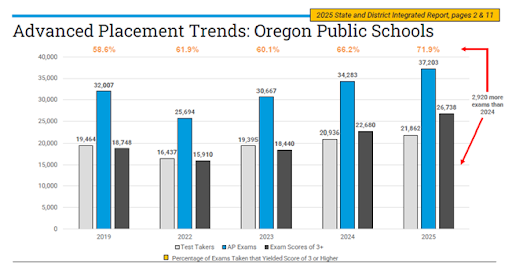
New data released by the College Board show that Oregon students with access to challenging courses continue to make strides in college readiness, particularly through the state’s growing participation and success in Advanced Placement (AP) coursework and exams.
According to the
2025 Advanced Placement State and District Integrated Report for Oregon, the number of Oregon students participating in AP courses has increased by 70% since 2021, including a 4% increase between 2024 and 2025. Oregon exceeded pre-pandemic participation levels in 2024, and participation continued to rise this year. In 2025, 21,862 Oregon students took 37,203 AP exams, up from 19,464 students taking 32,007 exams in 2019. Oregon’s High School Success initiative has played a key role in expanding access to advanced coursework.
Among the 2025 highlights:
- Participation in AP courses grew 4.4% overall from 2024, including a 16.2% increase among Black/African American students and a 4.1% increase among Hispanic/Latinx students.
- Overall participation in AP exams increased by 8.5% from 2024.
- 20.9% of AP test-takers qualified for the state-funded AP Test Fee Program for students experiencing poverty.
- The number of students receiving scores of 3, 4, or 5 increased by 32.9% for Black/African American students and 17.7% for Hispanic/Latinx students compared to 2024.
In addition to AP, many Oregon students also earn college credit through International Baccalaureate (IB) programs and dual credit or dual enrollment opportunities, which together provide multiple pathways for students to demonstrate college readiness and reduce the cost of higher education.
Through strategic investments and partnerships, Oregon is strengthening pathways for students to earn college credit while in high school through:
-
High School Success funds, created by Measure 98 (2016), which help schools expand access to accelerated college credit opportunities such as AP, IB, and dual credit courses, including CTE dual credit. These funds also support communication with students and families so they understand available options and how to access them.
-
ODE’s Student Success Plans and related grants, which provide districts with strategies to improve outcomes for historically underserved student groups. Each plan includes goals to increase college readiness, often through expanded accelerated credit opportunities.
- Collaboration between ODE and the Higher Education Coordinating Commission (HECC) through the AP/IB Policy Workgroup, which coordinates the
Statewide Course Credit Policy. The policy’s
online table shows how AP and IB exam scores translate to credit at Oregon’s 24 public colleges and universities, helping students plan their postsecondary pathways.
- State-funded exam fee support, as the legislature allocates funding each biennium to cover full AP and IB exam costs for students experiencing poverty and to reduce fees for all Oregon test-takers.
Together, AP, IB, and dual credit opportunities reflect the state’s ongoing commitment to expanding college readiness opportunities for all students, especially those historically underrepresented in higher education pathways. When given the opportunity to learn and high expectations, Oregon students are showing that they will rise to the occasion.
ODE In the News